
Engineering the Geothermal Heating and Cooling of Buildings
Geothermal Heating and Cooling of Buildings
Globally, we emit more than 50 billion tonnes of greenhouse gases each year, measured in carbon dioxide equivalents (CO2eq), with about 17.5% greenhouse gas (GHG) emissions being generated by the use of energy in buildings (Ritchie 2020). In the U.S., buildings account for more than one third of domestic climate pollution and $370 billion in annual energy costs (U.S. DOE 2024). A new comprehensive plan to reduce GHG emissions from buildings by 65% by 2035 and 90% by 2050 predicts consumer savings of more than $100 billion in annual energy costs and avoiding $17 billion in annual health costs (U.S. EERE 2024). To reach the overall GHG emissions reduction targets for the buildings sector, using geothermal energy and a new technology stack inspired by more than 50 years of oil and gas innovations can be quickly scaled up. The technology stack consists of an ultra-compact coiled tubing platform, real-time downhole telemetry hardware, and thermal subsurface modeling software. Using this multi-stack technology platform can significantly address the main adoption blockers of geothermal heating and cooling systems (i.e., affordability, predictability, and consistency) and greatly reduce the GHG emissions from buildings. The Earth’s temperature increases from atmospheric conditions to over 500°C in the lithosphere (the top layer of the crust), to around 1,000°C at the crust- mantle boundary, and to around 6,000°C at its center, with slight local variations within the first kilometers from the surface (Moncarz and Kurtyka 2023). At 10 kilometers of depth or shallower, just about every point on Earth has sufficient heat for power generation. And just about everywhere in the world, there is enough thermal energy within the first kilometer for heating and cooling of all our buildings.
“To reach the overall GHG emissions reduction targets for the buildings sector, using geothermal energy and a new technology stack inspired by more than 50 years of oil and gas innovations can be quickly scaled up. “
In his 2024 state of the Union address, U.S. President Biden spoke of how the Inflation Reduction Act (IRA) will cut America’s energy costs, create jobs, and transform the U.S. efforts to address the climate crisis. His goal is to cut GHG emissions in the U.S. by an additional 31-44% by 2030 – on top of the present policy reductions of 24-25% - by investing in and promoting renewable and alternative energy technologies such as wind, solar, geothermal, and nuclear. Geothermal energy usage is poised to grow significantly in the current policy environment. The IRA benefits through 2034 provide drillers with certainty when investing in geothermal technology. In particular, IRA offers a 30-50% Energy Investment Tax Credit (ITC) for companies that install geothermal heating and cooling systems, also called geothermal heat pumps, ground-source heat pumps, geo-exchangers, or geo-heat exchangers. Businesses can deduct this percentage of their equipment and installation costs from their tax liability. This amounts to lowering the upfront installation costs by up to 50%, making geothermal energy extremely cost competitive with traditional heating and cooling systems.
The amount of energy used per capita varies due to such factors as the local climate and economy, but about 25 percent of the total energy worldwide is used for heating and cooling of residential, commercial, and industrial buildings. Most of these systems use fossil fuels to generate heat, which is then converted into electricity, which is then transported through energy-losing wires, and is eventually converted into heating and cooling of buildings. Geothermal heating and cooling systems have a reduced carbon footprint of about 90% when compared to modern heating and cooling systems that rely on fossil fuels or conventional HVAC systems. Decarbonizing buildings not only reduces GHG emissions, but also provides an added benefit in terms of lowering energy costs: geothermal systems can cut heating costs by 30-70% and cooling costs by 20-50% compared to traditional systems (Kapusta et al. 2023).
“... about 25 percent of the total energy worldwide is used for heating and cooling of residential, commercial, and industrial buildings. Most of these systems use fossil fuels to generate heat.”
There are several technology variations of geothermal heating and cooling systems. In general, they have three parts: 1. the geo-field, consisting of 500- to 1,500-ft deep vertical boreholes providing a closed-loop network of pipes; 2. geothermal heat pumps; and 3. the building HVAC sub-system. Here, the focus is on the geo-field construction, as this is a natural extension of the experience and expertise from the oil and gas industry. For instance, defining large buildings as any buildings with an interior surface larger than 20,000 square feet, such as multi-family homes, commercial buildings, schools, universities, hospitals, military bases, warehouses, data centers, etc., a typical geo-field may consist of tens or hundreds or boreholes, with 10- to 25- ft between any two adjacent boreholes. Geothermal heating and cooling systems are not a new concept, with high- profile systems being installed in many locations in the U.S., from Boise, Idaho, to New York City (Robins et al. 2021). Despite having been established as a proven technology, geothermal heating and cooling has several challenges, which, if not solved, prevent it from being scalable fast enough to meet the decarbonization aspirations mentioned above. In terms of subsurface capabilities, accurate site characterization, sound design methodologies, effective control logic, and short and long-term (life-cycle) performance analysis and optimization have been missing. Most of the existing drilling and geo-field construction techniques are similar to those from the water well drilling industry and not from the oil and gas industry (Khaleghi and Livescu 2023).
“Significantly reducing the large LCOH variability of geothermal heating and cooling of buildings should reduce their average LCOH below the average LCOH of natural gas.”
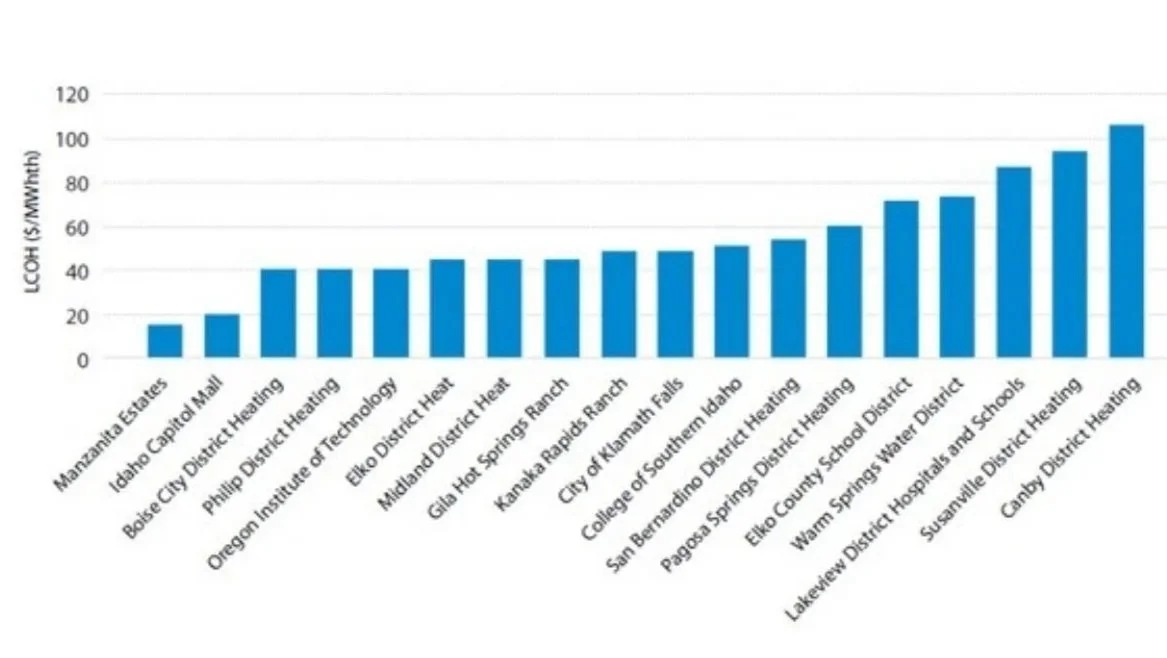
Figure 1: Estimated LCOH for selected U.S. geothermal heating systems (Robins et al. 2021).
The economic and thermal performance data of geothermal heating and cooling systems is sparse, and the levelized cost of heating (LCOH) of selected U.S. geothermal heating systems is shown in Figure 1 (Robins et al. 2021). For comparison, the LCOH of selected U.S. and European geothermal heating systems (“GDH”) and natural gas prices (“Natural Gas”) are shown in Figure 2 (Robins et al. 2021). Assuming very optimistic conditions of 30-year lifetime, 5% discount rate, and overnight construction, LCOH for the selected U.S. systems ranges from $15 to $105/MWhth, with an average of $54/MWhth, which is lower than the average European LCOH of $69/MWhth, but higher than the average 2019 U.S. price of residential natural gas (IEA 2020).
Significantly reducing the large LCOH variability of geothermal heating and cooling of buildings should reduce their average LCOH below the average LCOH of natural gas.This could be addressed by reducing the construction cost of geothermal heating and cooling systems and increasing their long-term energy consumption predictability and consistency.
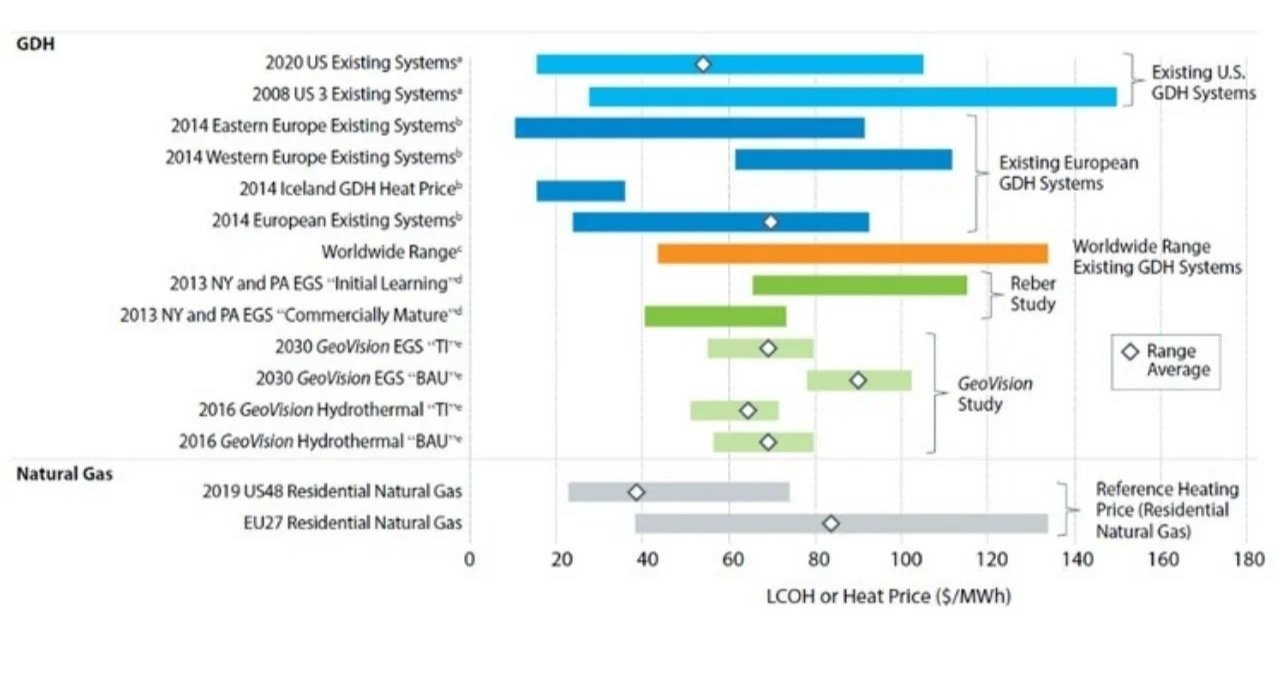
Figure 2: Comparison of LCOH values for selected U.S. and European geothermal heating systems and natural gas prices (Robins et al. 2021).
The slurry is then directed to the separation plant where hot-water extraction recovers the bitumen. At the initiation of oil sand production and until the stope is exhausted, the space created by production is continuously backfilled with an engineered paste. The paste backfill is composed of tailings, water, and binder and is pumped through a dedicated return line to a vertical paste deployment well, as shown earlier in Figure 2. Once the paste is deployed, drilling advances to the next section of the horizontal well by pulling back the casing and auger string, repeating the cycle. Unlike Imperial Oil’s Cold Lake borehole-mining pilots of the early 1990s, which relied on high-pressure hydraulic jetting in a vertical well, GABE™ uses mechanical conveyance within a confined system.
Unlike Imperial Oil’s Cold Lake borehole-mining pilots of the early 1990s, which relied on high-pressure hydraulic jetting in a vertical well, GABE™ uses mechanical conveyance within a confined system. This eliminates the open cavern geometry associated with earlier hydraulic methods and maintains control of stress redistribution within the McMurray Formation.
Engineering Geothermal Heating and Cooling of Buildings
To address the current geo-field construction uncertainties and technical challenges, a new geo-field construction platform has recently been developed and deployed in Austin, Texas (Torres et al. 2024). It consists of an ultra- compact coiled tubing unit, shown in Figure 3, with integrated wired telemetry for real-time measurement of downhole parameters such as pressure, temperature, thermal conductivity, borehole inclination, weight-on-bit, etc., similar to those developed for oil and gas coiled tubing technologies (Livescu et al. 2018) and novel physics-based and data-driven subsurface heat models, again, similar to those developed for oil and gas coiled tubing applications (Aitken et al. 2018).
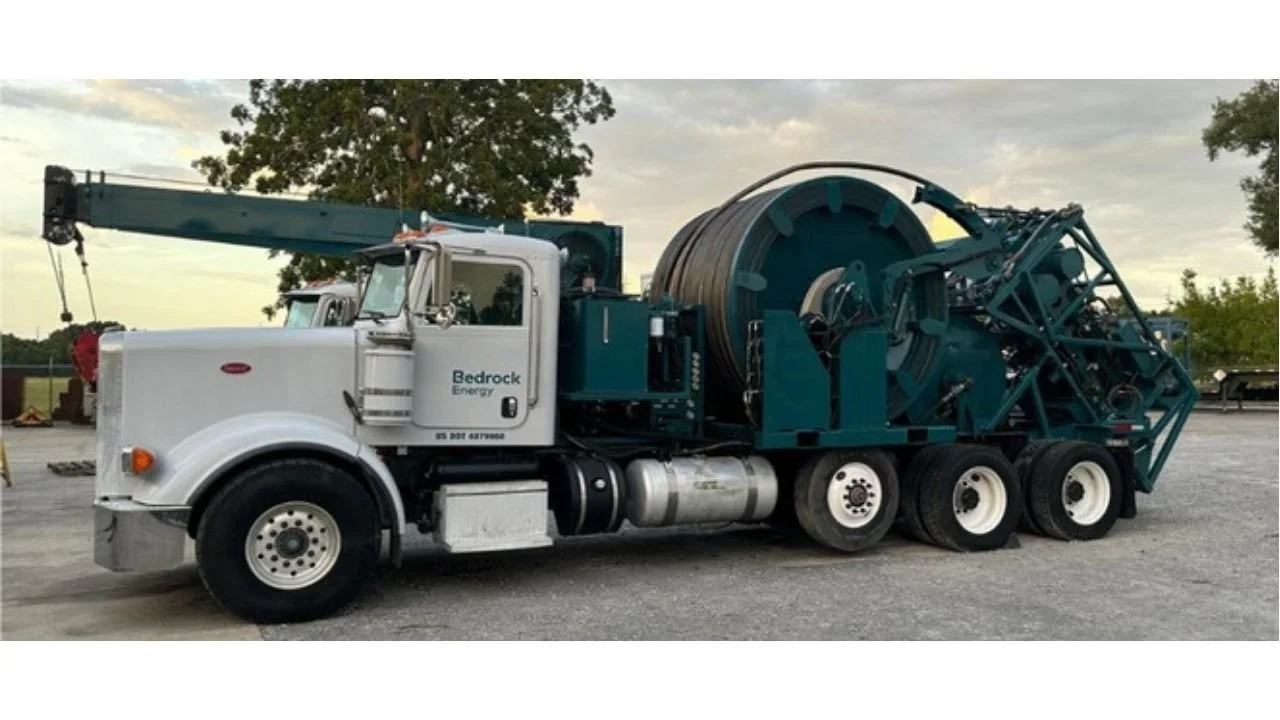
Figure 3: Example of a coiled tubing platform for shallow geo-field construction of large buildings in dense urban areas (Torres et al. 2024).
Coiled tubing drilling is not a new technology and has received a large amount of press since the 1990s. However, it has never become a mainstream oil and gas well drilling technique due to several technical shortcomings, such as requirements for additional pipe handling equipment, long bottomhole assemblies, and larger blowout preventer stacks, and technical and operational difficulties with large diameter coiled tubing. Unlike the oil and gas wells, currently the shallow geothermal boreholes for the geothermal heating and cooling of buildings larger than 20,000 sqft are usually 300- to 600-ft deep (with the ultra-compact coiled tubing unit being able to drill 2,000-ft vertical boreholes), 4.5- to 6.5-in. in diameter, and open-hole.
Thus, the geo-field construction for buildings is a great application for coiled tubing drilling due to its main advantages, including small footprint, high mobility, and quick operations. The workflow for constructing a geo-field is:
based on the building size, location, and climate, an initial geo-field is designed, yielding the initial number and depths of boreholes;
while drilling, the subsurface conditions are measured and updated on the fly, and new geo-field layouts are simulated after each borehole is constructed, yielding updated number and depths of boreholes;
once the final geo-field layout is constructed, the geo-field network of pipes is connected to the geothermal heat pumps and the building HVAC sub- system.
“ ... the geo-field construction for buildings is a great application for coiled tubing drilling due to its main advantages, including small footprint, high mobility, and quick operations.”
The extensive insights into the subsurface geological properties enable more efficient drilling operations, consequently reducing overall drilling costs and enhancing the financial viability of building heating and cooling projects. Further, during the operational phase, these models help maximize energy production potential while minimizing operational costs. One of the key innovations of this approach is the integration of the subsurface model with building energy models, making it possible to optimize the energy consumption of the entire building by more precisely matching energy demand with the corresponding energy source thereby addressing the issue of “thermal gap” between the subsurface domain and buildings.
“Using this multi-stack geo-field construction platform can not only greatly reduce GHG emissions from buildings, but also predictably and consistently reduce their average LCOH to about $30/MWhth, below the average LCOH of natural gas.”
This approach has been already proven in a first-of-a-kind project in Austin, Texas, where the innovative geo-field construction platform was recently deployed in a parking lot of a commercial building with tenants inside. Comparing to the current mainstream geo-field construction technologies consisting of rotary drilling rigs for water well drilling, this geo-field construction platform drilled three times faster and constructed a geo-field with a 60% smaller footprint, proving its affordability. The ability to measure downhole data in real time and update the geo-field layout on the fly is a powerful feature towards the long-term thermal performance predictability and consistency of the geothermal heating and cooling systems, which leads to the LCOH affordability, predictability, and consistency required for unlocking geo-field construction at massive scale. With extreme weather events from heat waves to cold weather anomalies increasing in frequency with a changing climate, geothermal heating and cooling presents as the low hanging fruit for increased reliability, resilience, comfort, and peace of mind for the built environment everywhere. Using this multi-stack geo-field construction platform can not only greatly reduce GHG emissions from buildings, but also predictably and consistently reduce their average LCOH to about $30/MWhth, below the average LCOH of natural gas (Bedrock Energy 2024).

Dr. Silviu Livescu is a co-founder and Chief Technology Officer of Bedrock Energy, a geothermal energy startup on the mission to radically reduce costs for people and the environment by transforming the heating and cooling of buildings. Previously, he was a tenured faculty of Geoenergy Science and Engineering at the University of Texas at Austin, a pressure pumping chief scientist at Baker Hughes, a research engineer at ExxonMobil, and a board technical director for the Society of Petroleum Engineers. He has authored 41 U.S. patents and patent applications and more than 100 papers and articles, and has extensive experience in multi-disciplinary research and technology development, innovation, intellectual property, product, strategy, and management applied to several geoenergy engineering (geothermal energy, direct air capture, carbon sequestration, underground thermal storage, and hydrocarbon production) technical disciplines, with focus on well engineering and operations (monitoring and telemetry systems, well drilling, construction, production, and data science and engineering analytics).