
Co-injecting Steam & Flue Gas in SAGD to Reduce Carbon Intensity
General Energy Recovery Inc. (GERI)
GERI (General Energy Recovery Inc.) is an energy transition technology company which will be featured at the world’s leading Carbon Capture and Storage (CCS) Conference, GHGT-17, being held in Calgary October 20-24, 2024. GERI’s Engineering Manager, Thomas Hartley is presenting an e-Poster at GHGT-17 on Tuesday at 3 PM on the topic of “Co‑injecting steam & combustion exhaust gas into SAGD wells: simultaneously utilizing and storing CO₂”.
“The idea around this presentation is that CCS is challenging and is proving difficult for a lot of reasons. GERI's technology has an immediate impact, the point of this presentation is to show roughly what's the scale of that impact,” Hartley explains. “GERI provides an alternative solution to putting carbon underground for long term storage by tweaking an already established SAGD injection practice. It's economic, the necessary infrastructure already exists and, therefore, it's a quick turnaround.”
According to Canadian Environmental Sustainability Indicators, GHG emissions from in-situ oil sands operations contribute 6% of Canada’s total GHG emissions. SAGD accounts for over three-quarters of the total in-situ production in Canada, the large majority coming from flue gas released to atmosphere during the production of high-pressure steam required to heat and mobilize the underground oil.
Currently in SAGD, large quantities of natural gas are being co-injected (with steam) as the industry’s go-to non-condensable gas (NCG), a process used to improve steam-oil-ratio (SOR) and carbon intensity. Co-injecting NCGs reduces the SOR on older wells, also allowing companies to re-allocate steam to younger, more productive wells; thereby further accelerating oil production of low carbon-intensity oil. Hartley says, “Steam makes a lot of GHGs, so reducing the SOR allows the production of more oil at a lower carbon intensity. And that’s how the industry is going to reduce emissions.”
GERI’s direct contact steam generation (DCSG) is markedly different than conventional steam generation technology, in that the flue gas resulting from steam generation are combined with the steam and injected downhole, with much of the CO₂ stored underground in the reservoir.
Using DCSG technology, GERI intends to swap out the costly natural gas used as an NCG and replace it with their flue gas (CO₂ and N₂), which provide a similar benefit to natural gas. Environmental benefits aside, this also allows GERI to become a cost-effective solution by drastically reducing the quantity of natural gas injected, cutting operating costs by about a third compared to equivalent volumes of steam and NCG.
Retention of carbon-dioxide (CO₂) in steam-assisted gravity drainage (SAGD) reservoirs doesn’t currently qualify for carbon credits, but ultimately there is a financial benefit,” Hartley notes. “We believe there's a path to have those volumes of carbon stored underground to be applied against the carbon tax that companies pay”.
In many CCS projects, the source of the CO₂ is located far from where it’s injected underground. This requires substantial new pipelines and wells, all of which come at a financial and environmental cost, not to mention the ongoing energy cost to gather, transport and inject CO₂ underground.
Hartley explains, “GERI's DCSG can be located directly on a wellpad, and that means you don't have heat losses from lengthy steam pipelines, and the CO2 generated is injected on site. The difference between using GERI versus most conventional CCS projects is that much of the big infrastructure costs are already built into the project.”
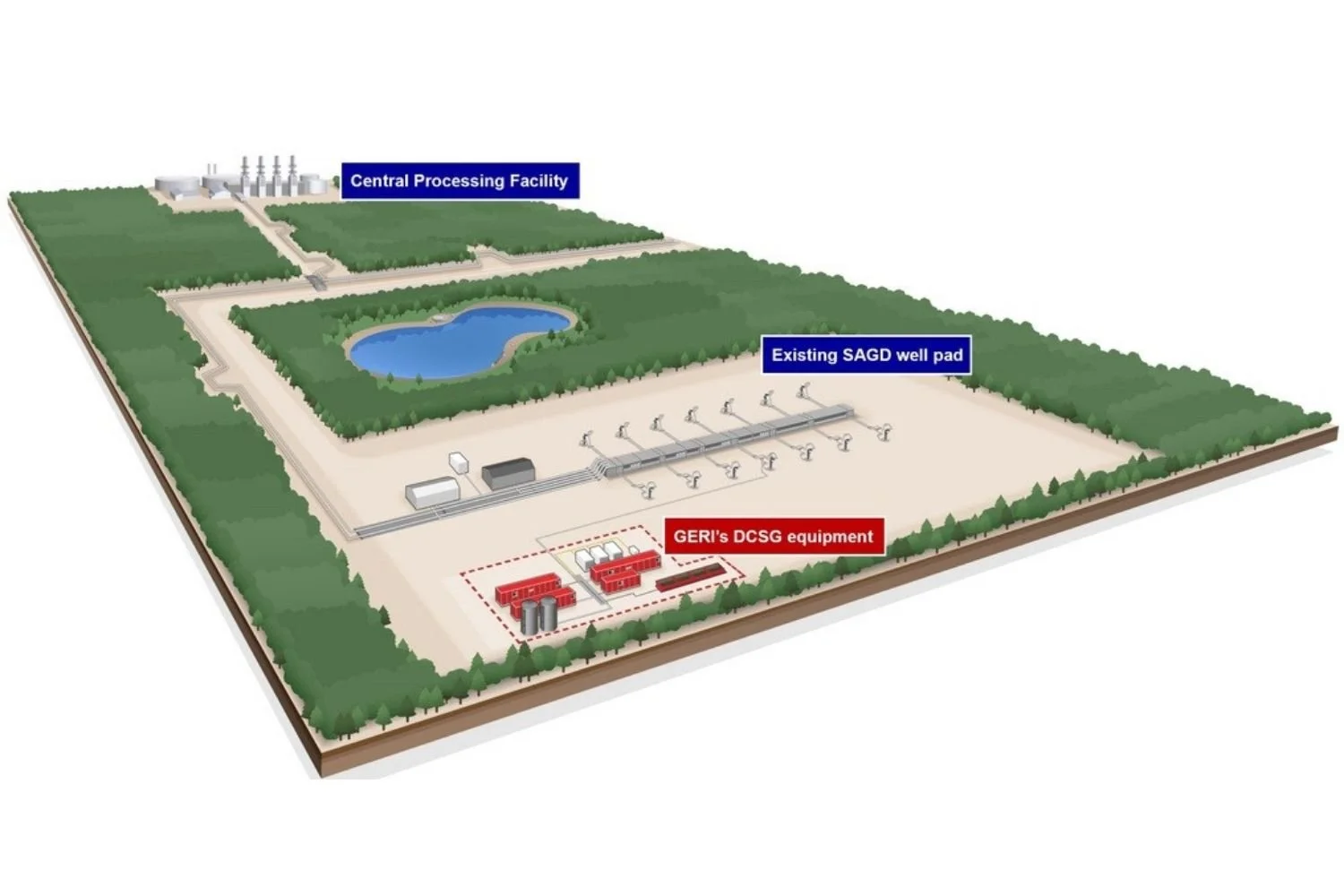
Image of GERI’s DCSG on a SAGD well pad with a CPF in the distance
Using flue gas in SAGD is different than conventional CCS, in that some portion of CO₂ will return to the surface during production. To help understand and quantify this, GERI is currently completing a third-party study with Dr. Maureen Austin-Adigio to determine the ideal timing, placement, duration, and quantity of NCG to inject in GERI’s operations. She will accompany Hartley to answer questions following his GHGT-17 presentation.
Hartley explains, “One of the reasons we are contracting new research is other studies have looked at using CO₂, N₂ or flue gas as an NCG, we're trying to determine and illustrate the ideal application for GERI’s technology based on our specific outputs”.
“The first results of the study showed that one typical single SAGD well-pair can store up to 1,500 tons of CO₂ using GERI’s technology. There are about 3,000 active well pairs in Alberta, indicating there is potential for a few million tons of CO 2 storage potential. However, the total quantity stored is an interesting thing to know, what really matters is the net difference in CO₂ .”
Taking a forward-looking estimate, Hartley believes GERI’s DCSG, compared to conventional co-injection of NCG, is 25% less carbon intensive when used in the last third of the life of a SAGD well. Although millions of tons of CO₂ can be stored underground, Hartley says the net difference is key. “To illustrate the scale of potential, achieving a 25% reduction in carbon intensity for late-stage of SAGD could reduce hard-to-abate emissions by one to two million tons peryear. For context, Canadian in-situ emits about 45 million tons a year in Canada.”